L2B: Learning to Balance the Safety-Efficiency Trade-off in Interactive Crowd-aware Robot Navigation
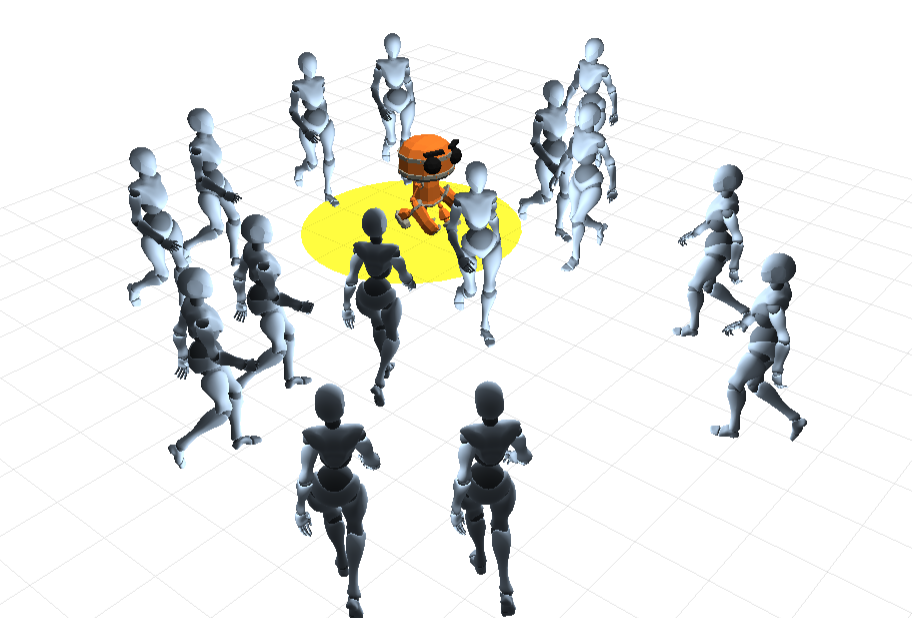
L2B lets a crowd-navigating robot choose between bypassing pedestrians and asking them to make room, using a reward shaped by sequential social dilemmas to balance safety and efficiency.
Motivation
How can agents learn to balance the safety-efficiency trade-off?
Most crowd-aware navigation methods only avoid collisions, and in dense crowds they hit the “freezing robot problem”: every forward path looks unsafe, so the robot stops or detours. A robot could instead ask nearby people to make room, for example with a beep. But clearing a path too often can collapse the crowd flow and raise the risk of collisions, and there is no optimal rule for when to do which.
Approach
L2B (Learning to Balance) is a deep RL framework whose actions add path-clearing beeps to movement. Treating the crowd as one agent, it casts robot-crowd interaction as a Sequential Social Dilemma: frequent passive avoidance is the sucker outcome, and aggressive path clearing is a temptation that can end in mutual defection. The reward adds a crowd term to the environment reward:
The first term penalizes beeping at pedestrians inside the beep range (the paper’s aggressiveness term); the second penalizes coming within the discomfort distance , with . L2B is applied to SARL (L2B-SARL); simulated pedestrians react to beeps via a simplified ERVO model.


Key results
- Circle crossing, 500 test cases per crowd size : on average, L2B-SARL vs. SARL: success 0.917 vs. 0.841, timeout 0.002 vs. 0.077, collision 0.079 vs. 0.081 (Table I).
- Densest crowd (): success 0.906 vs. 0.700, collision 0.094 vs. 0.184, timeout 0.000 vs. 0.116 (Table I).
- Trade-offs remain: at collisions are higher (0.118 vs. 0.064), and at SARL succeeds more often (0.922 vs. 0.904) (Table I).
- Adaptive path clearing: with , the learned beep frequency rises from 6.14% at to 12.92% at , then drops to 7.88% at (Fig. 5a).
![Effect of β (Fig. 5a in the paper): frequency %] of active path-clearing actions for each penalty factor β and crowd size N.
![%] of active path-clearing actions for each penalty factor β and crowd size N.](https://arxiv.org/html/2003.09207v2/agg_beep.png)
![Effect of β (Fig. 5b in the paper): success rate %] for each penalty factor β and crowd size N.
![%] for each penalty factor β and crowd size N.](https://arxiv.org/html/2003.09207v2/agg_success.png)
Conclusion
L2B gives the robot a second way to interact with a crowd, plus a social-dilemma reward deciding when to use it. The learned policy clears its path more often as crowds grow up to , but holds back in the most congested scenes. Balancing safety and efficiency thus becomes a matter of reward design, which points toward settings where pedestrians also clear paths or learn to cooperate.