
Interests
 PINNED
Self-Evolving Memory
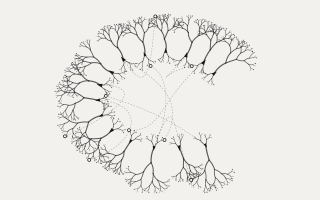
Memory infrastructure that lets AI agents and robots keep learning from intermittent streams of experience. Instead of a dataset fixed before training, memory is an ongoing process of accumulation, self-organization, and recall, so agents can autonomously discover and recompose skills and adapt to new environments. We study its retrieval infrastructure, retrieval-augmented robot learning, methods for distilling experience and models, and integration with foundation models. JST PRESTO, principal investigator (since 2025).
RA-LIROS 26ACL 26CoRL 26

Small Language Models (SLMs)
Small language models (SLMs) are expected to play a central role in large-scale agent orchestration thanks to their low inference cost, yet they face challenges of their own: at 3B parameters and below, limited memory capacity and a sharp drop in agentic abilities such as tool use. We study post-training methods that draw out the capabilities of SLMs, and their integration with non-parametric external memory that compensates for what they lack. Robot foundation models also fall into this size class, making them a promising application.
ACL 26CoRL 26

Distributional Anchoring
The generalization of foundation models is easily broken by careless post-training. We study distributional anchoring: acquiring new capabilities while staying close to the original, well-generalizing distribution. Low-rank adaptation, co-training, and language-as-action can be viewed as anchoring to that distribution at the weight, data, and output levels, respectively, and distillation as pulling a model toward a well-behaved reference distribution.
ACL 26CoRL 26
Social Intelligence
Rather than referential AI that labels knowledge about the world, we focus on social intelligence: AI that evolves as a member of human society. We study shared memory and skills among agents, coordination among small AI models and robots, and socially aware navigation through crowd modeling.
CHI 24IROS 24IJCV 23RA-L 22BMVC 21IROS 20
Talks
Portable & Reproducible Research Environments in the Age of AI Agents
ロボット学習における大規模検索技術の展開と応用
Press coverage
Pet projects
Posts
Background
Experience
- 2023—Senior ResearcherOMRON SINIC X
- 2019—2023Research EngineerOMRON SINIC X
- 2017—2019Senior Software EngineerFixstars
- 2015—2017ResearcherNTT Labs
- 2013—2015Web Application Engineer (part-time)Hatena
- 2013Research InternIBM Tokyo Research Laboratory
- 2012Software Engineer Intern (BOLD)Google, Chrome / Native Client
Education
- 2020—2023Ph.D. in InformaticsKyoto University
- 2013—2015M.S. in InformaticsKyoto University
- 2009—2013B.E. in Electrical and Electronic EngineeringKyoto University
Service
Reviewer — ICCV 2023, CVPR 2023, IROS 2023–2024, ICRA 2024, TPAMI, WACV 2022, ICPR 2022, 3DV 2020–2021, MVA 2021
Career break
- Jan—May 2024Maternity leave for identical twins
Grants & Awards
Research grants
- 2025—JST PRESTO — Principal Investigator経験の蓄積と想起を司る自律型記憶基盤
- 2023—2026JST AIP Acceleration Research — Co-Investigator超高速データサイエンス
- 2025—2027JSPS Grant-in-Aid for Challenging Research (Exploratory) — Co-Investigator群ロボットの身体化における認知メカニズムの解明と制御論の構築
Awards
- 2023山下記念研究賞Information Processing Society of Japan (IPSJ)
Publications
2026
2026
2026
2026
2025
NeurIPS WS
2025
CoRL WS
2024
2024
IROS
2024
2023
2022
RA-L
2022
2022
2022
IEEE Access
2021
VTC-Fall
Preprints
2026