Lost in Translation? Democratizing VLAs through Language-Anchored VLM-to-VLA Adaptation
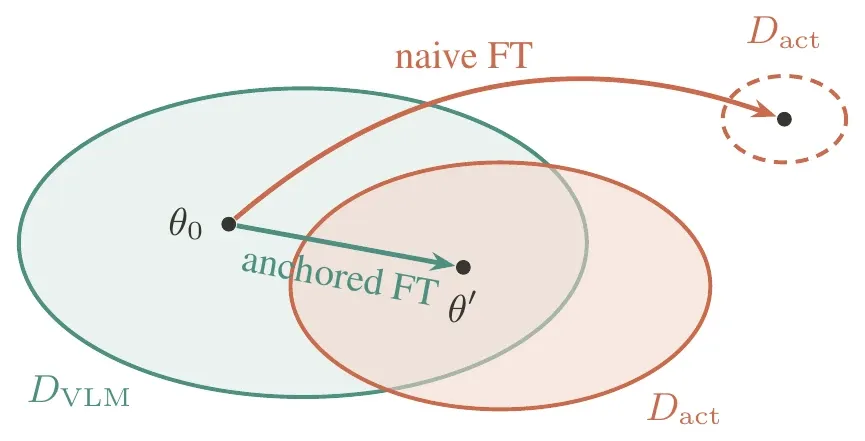
Language anchoring turns a stock VLM into a real-robot VLA from 120 demonstrations, with a template action prefix and co-training on a teacher VLM's descriptions of the robot's own frames.
Motivation
Can a VLA be built in low-resource settings, without massive annotation or dataset construction?
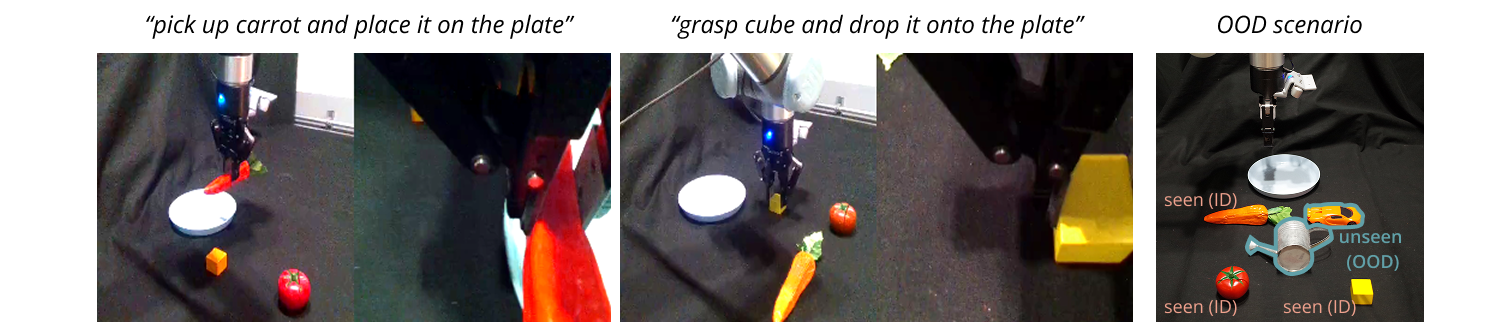
Action experts, learned tokenizers, and numeric behavior cloning pull a VLA out of its VLM’s pretrained distribution. The zero-modification VLA-0, which writes actions as numeric text, is brittle with little data. On a cluttered real-robot pick task with 120 demonstrations, a 2B VLA-0 policy reaches 15% in-domain and 5% with unseen distractors; flipping the input changes its predictions almost arbitrarily, and its attention locks onto shadows rather than objects.
Approach
A distribution anchor is any change to training that keeps the fine-tuned weights near the pretrained ones. Language anchoring does this with language targets at two levels, with no architecture or tokenizer change.
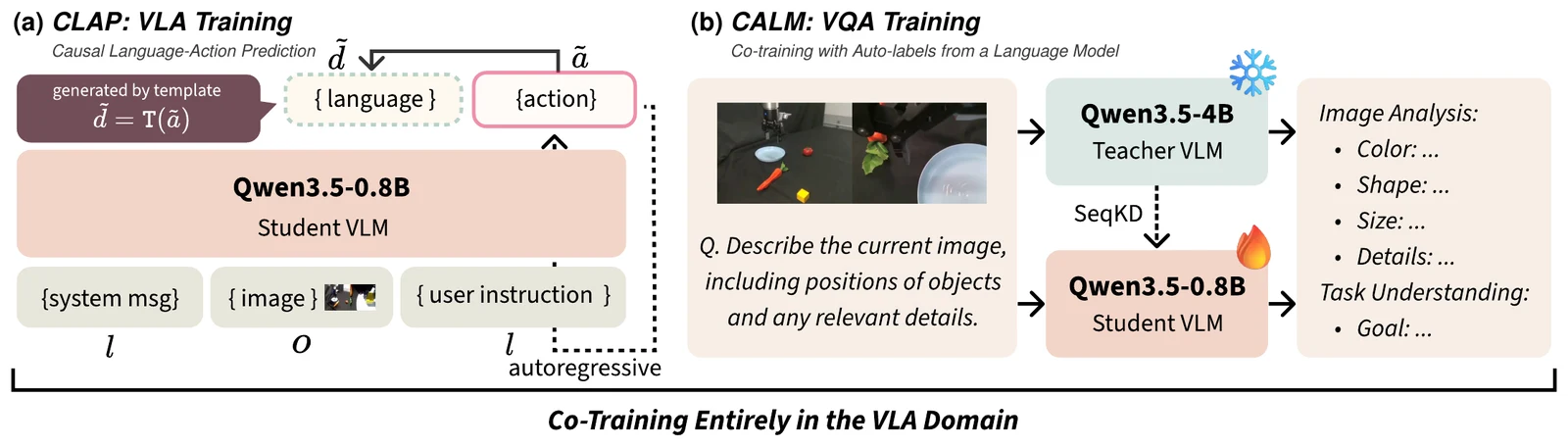
- Output level (CLAP): a fixed template renders the ground-truth action chunk in centimeters and degrees (“move back 0.5 cm, …, open gripper”).
- Data level (CALM): a frozen teacher VLM of the same family describes the robot’s own training frames, and the student is distilled on these descriptions. Each step draws a VQA sample with probability :
Key results
-
Real UR5e: with the prefix alone (CLAP), a 0.8B policy reaches 25% in-domain and 10% with unseen distractors. CALM with a 4B teacher raises it to 85% and 50%; a 4B student with the same teacher reaches 80% and 65%. Success rates (%) over 20 trials per configuration, 120 demonstrations:
Policy Teacher and prompts In-domain Unseen distractors VLA-0 2B, no prefix – 15 5 CLAP 0.8B – 25 10 CLAP 0.8B + CALM 0.8B: describe, describe and act 30 n/a CLAP 0.8B + CALM 0.8B: + poem, song, shakespeare 55 n/a CLAP 0.8B + CALM 4B: describe, describe and act 85 50 CLAP 4B + CALM 4B: describe, describe and act 80 65 -
Teacher quality matters more than prompt variety: adding poem, song, and shakespeare prompts to the 0.8B teacher raises success from 30% to 55%, while the 4B teacher reaches 85%. The teachers’ targets for the first UR5e frame show why (verbatim excerpts):
Teacher 0.8B describe Hallucination
“… A long, orange, carrot-shaped object with green leaves attached is lying horizontally in the lower-left area. … Right Side: … Action: The robot arm is holding the carrot and tomato together.”
Teacher 4B describe Grounded robot + gripper state
“… A robotic arm (looks like a UR5 or similar industrial arm) is visible in the top left, hovering over the plate. Its gripper is open. … Right Panel: … The robotic gripper is holding the orange carrot by its green leaves.”
Teacher 0.8B describe and act Plan OK, then drifts into irrelevant code
“1. Grasp the Carrot … 3. Drop the Carrot: … release it from the gripper and drop it onto the light blue plate. 4. Confirm Placement. … Final Output python # This is a Python script that demonstrates the task …”
Teacher 4B describe and act Cross-checks views, revises state
“The robot gripper is hovering near the carrot but hasn’t grasped it yet. Wait, looking closer … Actually, looking at the right image, the gripper is holding the carrot. Let’s re-evaluate.”
Teacher 0.8B poem Poetry set
The robot’s fingers, dark and precise, / Reach out to the carrot, green and bright. / It grasps with steady, careful hands, / And drops it gently onto the plate.
Teacher 0.8B song Poetry set
… With a gentle, careful touch. / The carrot is ready, / To be dropped onto the plate.
-
The anchor needs language about the task: on the LIBERO simulation benchmark (2B), random words barely help (79.0 vs. 75.9), and a numeric prefix trails on long tasks (74.4 vs. 82.0). Success rates (%) by prefix:
Prefix Spatial Object Goal Long Avg none (VLA-0) 77.8 86.6 77.0 62.4 75.9 random words 79.2 84.0 85.6 67.0 79.0 numeric, no language 91.2 98.2 90.8 74.4 88.7 language (CLAP) 93.0 97.4 90.8 82.0 90.8
Conclusion
Anchor first, scale later. Learn new tasks while keeping the general capabilities of the foundation model: two language anchors make a 0.8B VLA robust on a real robot from 120 demonstrations.